


Protected Growth and Guaranteed Income in a High-Rate, High-Risk World
Why consider now?
Stocks are at record highs and long-term yields are the highest in more than two decades. That combination makes this a good time to look at strategies that trade some upside for defined downside protection, a fixed rate of growth, or a personal pension to provide long-term stability.
At the close on October 6, 2026, the S&P 500 finished at a record 7,818.93 (+0.58%) and the Nasdaq also closed at a record, while the 10-year Treasury yield ended at 5.27%, just off its highest level since April 2002 set the day before (Yahoo Finance close; Yahoo Finance). The Federal Reserve raised its target range to 3.75%–4.00% on September 16 (Vantage Markets).
For most Canopy clients, actively managed portfolios remain the core. This includes our lineup of custom strategic themes and tactical Dual Defense™ portfolios. But when valuations are stretched and rates are elevated, insurance companies and banks can offer options like annuities and structured investments that might be an attractive alternative to the emotional roller-coaster of traditional investment strategies.
This post walks through the details to provide an objective view and demystify prior stereotypes. We'll discuss what annuities and structured investments are, how they work, and where they may fit in your asset allocation and retirement plan.
These are not your parent's and grandparent's annuities
The old stereotype of annuities — high and hidden fees, long lock-up periods, and big commissions — grew mostly out of variable annuities with stacked riders. Today's protection-oriented contracts available to Canopy Financial clients work very differently.
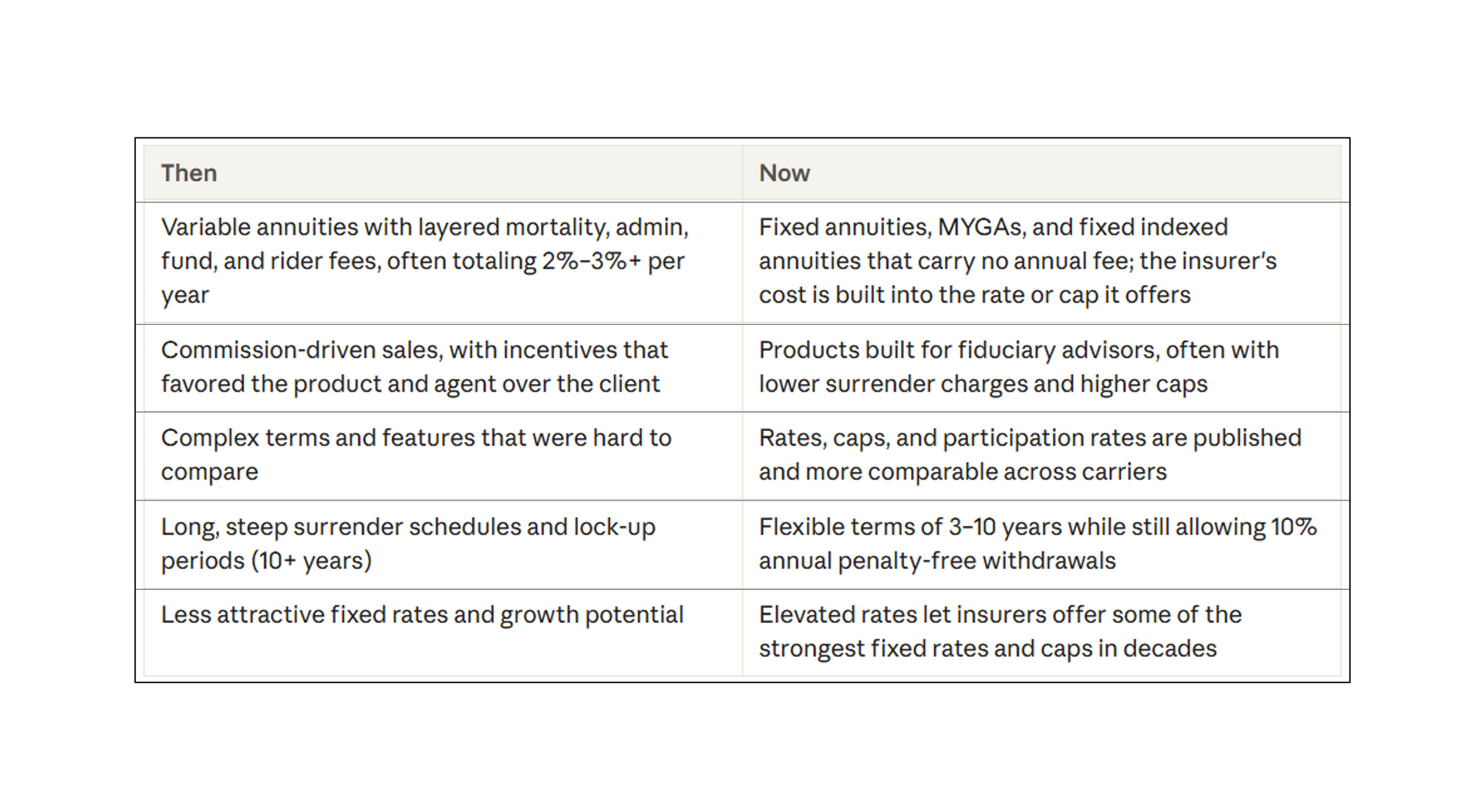
What hasn't changed: annuities are long-term contracts, guarantees depend on the issuing insurer's claims-paying ability, and withdrawals before age 59½ may face a 10% IRS penalty. The point isn't that annuities are right for everyone. It's that the old drawbacks are no longer a reason to blindly rule them out.
Three features make these products worth a look, especially for more risk-averse investors:
- Defined downside (known outcome). Principal protection (fixed and fixed indexed annuities) or a known buffer or barrier (structured notes), set before you invest.
- Known rates. A contractual rate for a set term, which is easier to plan around than a bond fund's changing yield.
- Tax deferral. Annuity growth is tax-deferred until withdrawn, which can help in taxable accounts.
Let's take a closer look at different types of annuities designed for different investor objectives and risk profiles:
Fixed annuities and MYGAs: a known rate for a known term
A multi-year guaranteed annuity (MYGA) is the simplest of the group: the insurer credits a fixed rate for a set term, much like a CD. A traditional fixed annuity is similar, but its rate may be set for only the first year and reset after.
Key features:
- Contractual rate for 3, 5, 7, or 10 years, backed by the issuing insurer's claims-paying ability.
- No market exposure. Your account value does not fall when stocks or bonds do.
- Tax-deferred growth until withdrawal.
- Liquidity limits. Most allow about 10% free withdrawals a year; more than that during the term triggers surrender charges and possibly a market value adjustment (MVA).
- At maturity, you can take the money, renew, annuitize, or move to another annuity through a 1035 exchange.
Rates today are worth noting. As of October 6, 2026, the highest advertised 5-year MYGA rate was 6.65% and the highest 7-year was 7.10%, both from A- rated carriers, while an A++ rated carrier offered 5.90% for 10 years (My Annuity Store).
The highest rates often come from lower-rated insurers or use simple rather than compound interest, so carrier strength and crediting method matter as much as the headline number.
Who they may fit: investors who want a CD- or Treasury-like return with tax deferral, and who will not need the money for the full term.
Fixed indexed annuities: some upside, a 0% floor
A fixed indexed annuity (FIA) links your interest credit to an index, such as the S&P 500, but never credits less than 0% in a down year. You give up part of the upside in exchange for that floor.
How the credit is set:
- Floor: usually 0%. If the index falls, you earn nothing that period, but you don't lose principal or prior credits.
- Cap: the most you can earn in a period (for example, an 8% cap means a 15% index gain credits 8%).
- Participation rate: the share of the index gain you receive (for example, 50% participation on a 12% gain credits 6%). Some strategies offer uncapped participation.
- Spread or margin: a percentage subtracted from the index gain before crediting.
- Crediting period: commonly annual point-to-point; some use 2- or 3-year terms with higher participation.
Why these details matter: credits lock in each period (the "reset"), so a bad year does not erase earlier gains. And most index credits exclude dividends, so an FIA should not be compared with an index's total return.
Insurers fund these options from the yield on their general account, so higher interest rates generally support higher caps and participation rates. Many FIAs also offer optional income riders for lifetime withdrawals, usually for an added annual fee.
Trigger strategies: a credit in flat or down years
Many FIAs now offer trigger-style crediting alongside traditional caps and participation rates. These let an FIA credit interest even when the index goes nowhere, or falls.
- Performance trigger: credits a declared rate (for example, 7%) if the index is flat or up over the crediting period, even if it rose only slightly. Gains above the trigger rate are given up. If the index falls, the 0% floor applies.
- Dual trigger: credits a declared rate if the index is up, flat, or down. On some contracts the decline must stay within a set range; a larger decline credits 0%, not a loss.
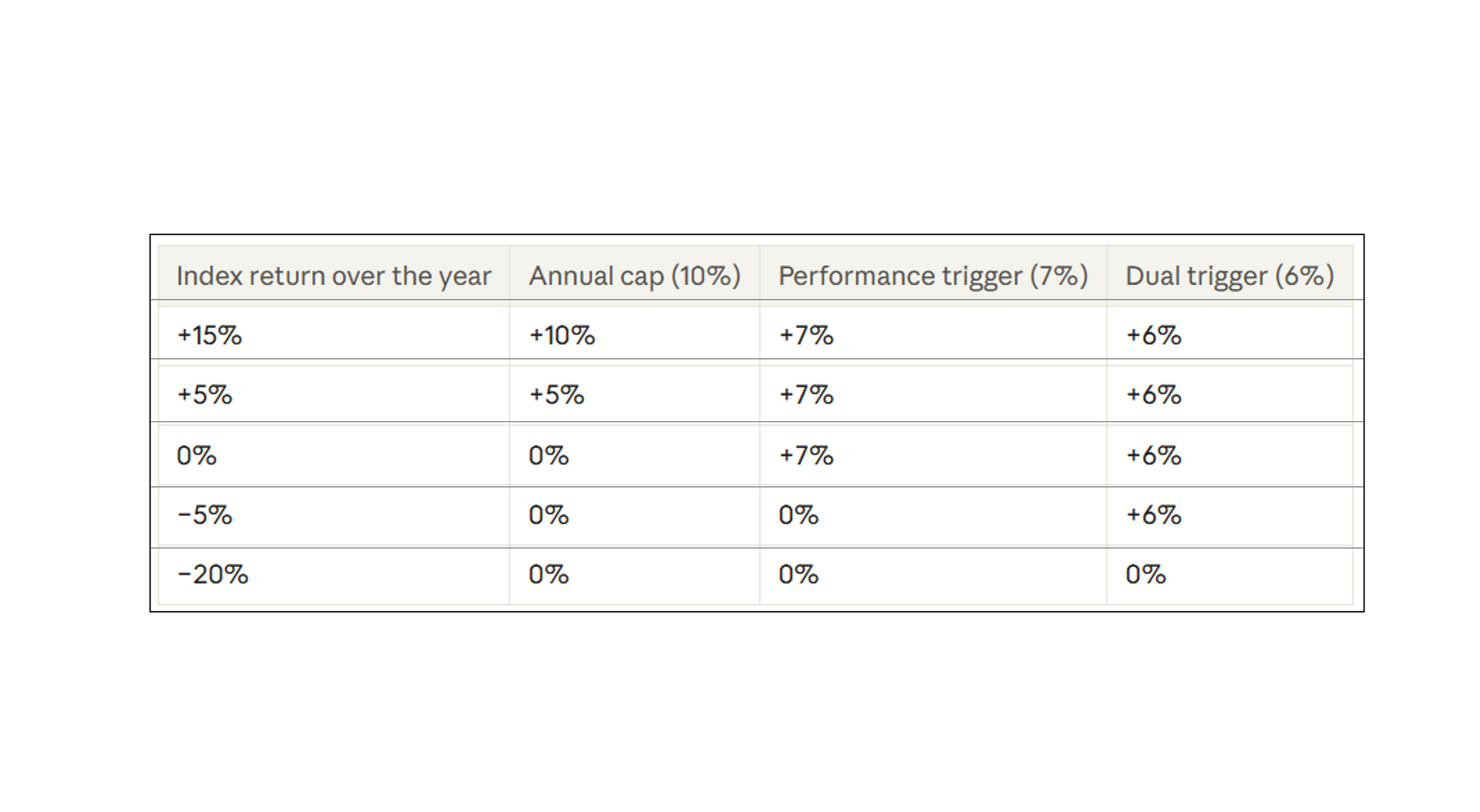
Hypothetical terms: the dual trigger credits if the index ends no more than 10% below its start. Rates are illustrative only, not actual offerings; actual rates vary by carrier and are reset each crediting period.
Because of the 0% floor, the worst case in a trigger strategy is a zero credit for that period, not a loss of principal. That is the key difference from the structured notes below.
Who they may fit: investors who want some equity-linked growth but cannot accept a loss of principal, often as a bond alternative or a bridge to retirement income.
Structured investments: growth notes and income notes
Structured notes are bank-issued debt whose payoff is tied to an index or basket over a set term, usually 1–7 years. They can be built for growth or for income, with a defined level of downside protection agreed up front.
Growth notes aim to participate in index gains, sometimes with leverage, up to a cap or uncapped:
- Example: 150% upside participation up to a 20% cap, with a 15% buffer over 3 years.
- Some offer full principal protection at maturity in exchange for lower participation.
- Dual Directional (getting paid when an index falls) also called absolute return notes, pay for index gains and also pay the absolute value of index losses, down to a barrier. If the index ends down 15% and the barrier is 30%, you earn +15%. Below the barrier, the protection falls away and you take the full index loss.
Income notes pay a coupon that is often well above bond yields:
- Fixed coupon notes pay a set rate regardless of index level.
- Contingent coupon notes pay only when the index is at or above a coupon barrier on each observation date (for example, 70% of the starting level). Some include a "memory" feature that pays missed coupons later if the index recovers.
- Autocallable notes end early and return principal if the index is at or above a set level on a call date, which can shorten the expected holding period.
Buffers vs. barriers — the most important distinction in a note:
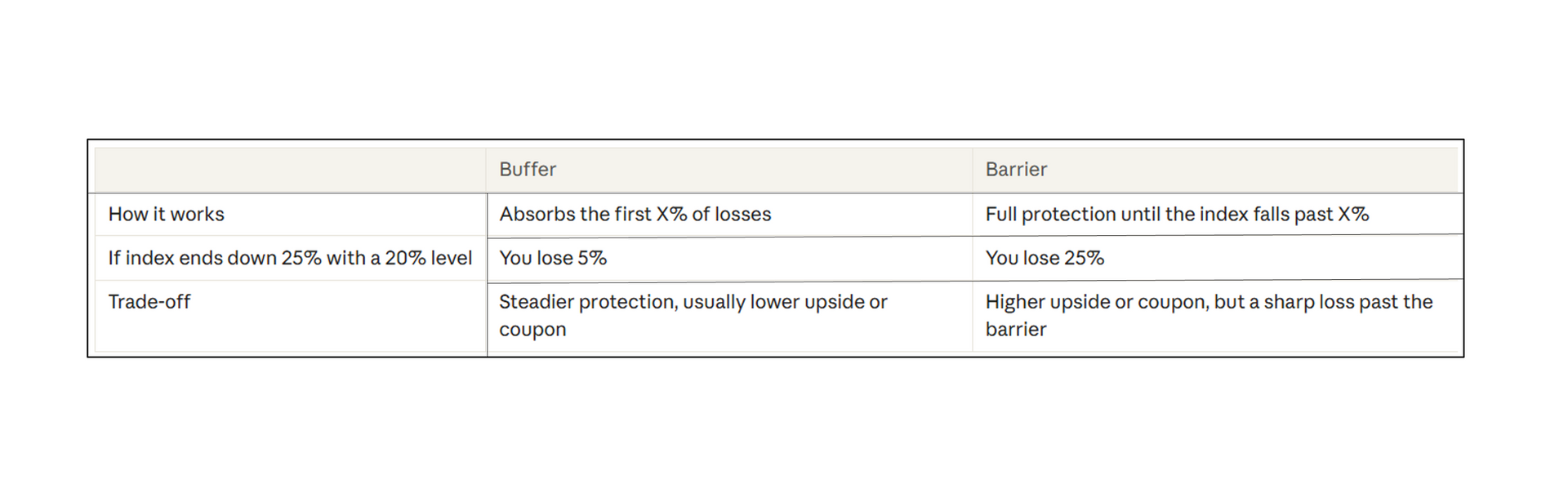
Notes typically have no annual fee; the bank's cost is built into the terms. They are generally illiquid before maturity, subject to the issuer's credit risk, and not FDIC insured.
Who they may fit: investors who want a defined outcome over a set period and are comfortable holding to maturity.
Where do all these fit in your portfolio?
These tools can stand on their own, or they can replace part of an existing equity or fixed income allocation. The choice depends on what you want the money to do.
As a standalone strategy
- A MYGA ladder (for example, 3-, 5-, and 7-year contracts) for money you want to grow at a known rate, with maturities staggered for access.
- An FIA for a pre-retiree who wants growth potential without principal risk, with an optional income rider later.
- A ladder of structured notes with staggered maturities, so not all of the money is exposed to one point in time.
As a replacement for part of fixed income
- A MYGA can stand in for intermediate bonds or CDs, locking a rate for the term without the price swings of a bond fund.
- An FIA can serve as a bond alternative with upside tied to equities and a 0% floor; performance and dual trigger strategies can add a credit in flat or modestly down years.
- Income notes can add yield above traditional bonds, with the added risk of equity-linked downside past the barrier.
As a replacement for part of equities
- Buffered growth notes can keep equity exposure while defining how much of a decline you absorb — a way to stay invested near record highs without full downside exposure.
- Dual directional notes can reposition a slice of equities toward a sideways or modestly lower market.
In practice, we would size these to your liquidity needs, time horizon, and tax situation, and coordinate them with your existing managed portfolio rather than treat them as a separate bet.
Key risks to weigh:
- Opportunity cost. Caps and fixed rates limit upside; in a strong rally these will likely trail the index.
- Liquidity. Surrender charges, MVAs, and thin secondary markets make these poor homes for emergency money.
- Credit risk. Protection is only as strong as the insurer or bank behind it. These are not FDIC insured (state guaranty associations provide limited annuity coverage).
- Barrier risk. Losses past a note's barrier can equal the index's full decline.
- Reinvestment risk. When a MYGA matures or a note is called, rates may be lower.
- Complexity and taxes. Crediting methods and note payoffs vary widely, and early annuity withdrawals before 59½ may face a 10% IRS penalty.
The takeaway
With the S&P 500 at record levels and the 10-year Treasury yield near its highest level since 2002, defined-outcome strategies may deserve a place in the conversation. Today's fixed annuities, MYGAs, FIAs, and structured notes offer clearer terms and lower costs than the stereotype suggests, and current rates support some of their best terms in years.
They are not a replacement for a diversified portfolio, and each gives up something — upside, liquidity, or both — in exchange for protection or a known rate. If you would like to see how one of these might fit alongside your current portfolio, reach out and we can walk through it together.
Important disclosures
Canopy Financial Solutions is a registered investment adviser. This content is for informational and educational purposes only and is not personalized investment, tax, or legal advice, nor an offer or solicitation to buy or sell any security or insurance product. Investing involves risk, including the possible loss of principal.
Annuities. Annuities are long-term insurance contracts. Guarantees are backed solely by the financial strength and claims-paying ability of the issuing insurance company. Withdrawals may be subject to surrender charges, market value adjustments, and ordinary income tax, and withdrawals before age 59½ may be subject to a 10% IRS penalty. Optional riders carry additional fees. Fixed indexed annuities are not securities and do not directly participate in any stock or index investment. Annuities are not FDIC insured, not bank guaranteed, and may lose value. Rates cited are as of the date noted, are not offers, and are subject to change.
Structured investments. Structured notes are unsecured debt obligations of the issuer and are subject to the issuer's credit risk. They are not FDIC insured. Protection features such as buffers and barriers apply only if held to maturity. Notes may have limited or no secondary market and may be sold before maturity at a loss. Returns may be capped and generally do not include dividends on the underlying index. Hypothetical examples are for illustration only and do not represent actual offerings or results.
Opinions and forward-looking statements. The opinions expressed are those of the author as of the date of publication and are subject to change without notice. Forward-looking statements, including views on markets, interest rates, and economic conditions, are based on current expectations and assumptions that may not be realized. Actual results may differ materially.
Index and data sources. Index performance is provided for illustrative purposes only, does not reflect the deduction of fees or expenses, and does not represent the performance of any Canopy portfolio. Indexes are unmanaged and cannot be invested in directly. The S&P 500 Index is a market-capitalization-weighted index of 500 leading U.S. large-cap companies. Market data and third-party information are obtained from sources believed to be reliable, but their accuracy and completeness are not guaranteed.
For full disclosures and disclaimers, including information about Dual Defense™ technologies licensed from AlphaDroid and SumGrowth Strategies, LLC, visit https://www.canopyfinsol.com/disclaimers.
Sources
- Yahoo Finance: Stock market today, Oct. 6, 2026 (closing levels) (Oct. 6, 2026)
- Yahoo Finance: S&P 500 hits record high as oil prices and yields fall (Oct. 6, 2026)
- Vantage Markets: S&P 500 nears record as jobs miss and 10-year yield tops 5.3% (Oct. 6, 2026)
- My Annuity Store: MYGA rates (updated Oct. 6, 2026)